

Hey there! I'm a supplier of Single - Rail RGVs, and today I wanna chat about how these nifty machines handle obstacles during operation.
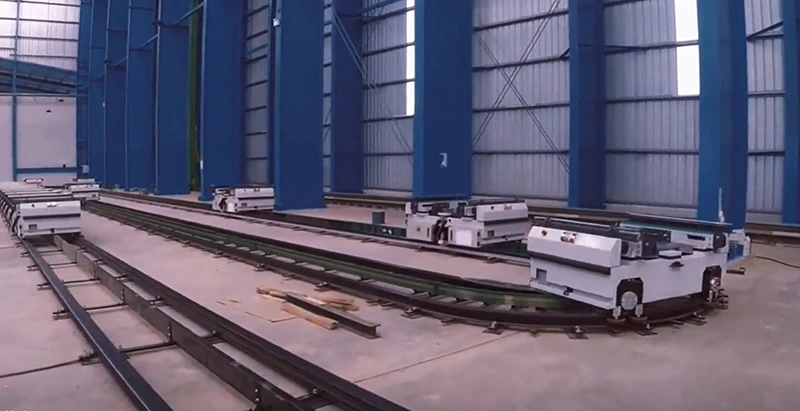
Single - Rail RGVs, or Rail Guided Vehicles, are a crucial part of many automated warehousing and logistics systems. Single-Rail RGV operate on a single rail, moving goods efficiently from one point to another. But just like any other moving equipment, they're bound to run into obstacles from time to time.
Sensors: The First Line of Defense
One of the most important ways Single - Rail RGVs deal with obstacles is through sensors. These little devices are like the RGV's eyes and ears. There are different types of sensors used, such as laser scanners and ultrasonic sensors.
Laser scanners work by emitting laser beams and measuring the time it takes for the beams to bounce back. If an obstacle is in the path of the RGV, the laser beam will hit it and return quicker than if there was no obstacle. The scanner can then calculate the distance to the obstacle and send this information to the RGV's control system.
Ultrasonic sensors, on the other hand, use sound waves. They emit high - frequency sound waves and listen for the echoes. When an obstacle is present, the sound waves bounce back faster, and the sensor can detect it. This is a great solution for detecting obstacles at close range.
Once the sensors detect an obstacle, they immediately send a signal to the control unit of the Single - Rail RGV. The control unit then decides what to do next.
Emergency Stop and Re - Routing
In most cases, when an obstacle is detected, the first thing the RGV will do is come to an emergency stop. This is a safety measure to prevent any collisions that could damage the RGV or the goods it's carrying. The emergency stop function is designed to be fast and reliable. All the RGV's motors are quickly shut down, and the brakes are applied.
After the emergency stop, the control system starts to analyze the situation. If it's possible to re - route the RGV around the obstacle, the system will calculate a new path. This requires a detailed map of the rail network. The RGV's control unit can communicate with the central control system, which keeps track of all the available routes.
Comparison with Other Guide Vehicles
Let's compare Single - Rail RGVs with some other types of guide vehicles. For example, Loop-Track RGV follow a loop - shaped track. While they also use sensors to detect obstacles, their re - routing options are more limited because of the fixed loop design. Once an obstacle is detected on the loop, the vehicle often has to wait until the obstacle is removed.
QR Code - Guided AGV use QR codes on the floor to navigate. They can be quite flexible in terms of path planning, but they rely heavily on the accuracy of the QR code placement. If an obstacle covers a QR code, the AGV may have trouble finding its way.
Track - Switching RGV can switch between different tracks. This gives them more options when dealing with obstacles. However, the track - switching mechanism adds complexity and cost to the system.
Laser - Guided Trackless AGV use lasers to create a map of their environment. They are very flexible in avoiding obstacles but can be more expensive and sensitive to environmental changes, such as dust or reflections.

Maintenance and Calibration
To ensure that Single - Rail RGVs can effectively deal with obstacles, regular maintenance and calibration are essential. The sensors need to be cleaned and checked regularly. Dust, dirt, or damage can affect their performance.
Calibration ensures that the sensors are accurately detecting distances. If the sensors are not calibrated correctly, they may give false readings, which could lead to the RGV not reacting to real obstacles or making unnecessary stops.
The control system also needs to be updated regularly. New algorithms can be installed to improve the RGV's obstacle - avoidance capabilities. This could include better path - planning algorithms or more accurate emergency - stop procedures.
Real - World Examples
In a large e - commerce warehouse, Single - Rail RGVs are used to move goods from the storage areas to the packing stations. One day, a forklift accidentally left a pallet in the path of an RGV. The RGV's laser scanner detected the pallet from a distance and immediately initiated an emergency stop.
The control system then analyzed the situation. There was an alternate route available, so the RGV was re - routed. It smoothly made its way around the obstacle and continued its journey to the packing station without any major delays.
Conclusion
So, as you can see, Single - Rail RGVs have several effective ways to deal with obstacles during operation. From advanced sensors to smart re - routing capabilities, they're designed to keep your operations running smoothly.
If you're in the market for an efficient and reliable material - handling solution, consider our Single - Rail RGVs. We've got the expertise and the technology to provide you with the best equipment for your needs. Whether you're a small business or a large - scale industrial operation, our Single - Rail RGVs can help you streamline your logistics and improve your productivity.
If you're interested in learning more about our products or discussing a potential purchase, don't hesitate to reach out. We're always happy to chat and help you find the right solution for your business. Just leave a message or get in touch, and we'll get back to you as soon as possible.
References
- Warehousing Automation Handbook, Author Name, Publisher Name, Year of Publication.
- Journal of Logistics and Supply Chain Management, Vol. X, Issue Y, Article on RGV Technology, Year.